| Glenn |
Since OS X 10.7 Java is not (pre-)installed anymore, let’s fix that. As I’m writing this, Java 11.0.4 is the latest version and AdoptOpenJDK is one of the best places to find Prebuilt OpenJDK Binaries.Easy to follow details about how to install OpenJDK are available here. However, the easiest way is to select OpenJDK 11 (LTS), the HotSpot JVM, and macOS x64, which will expose two option.
- If Java is already installed but applets do not work, you may need to check and see if Java is enabled. SOLUTION To see whether your browser is configured to use Java, check your settings in the Java Control Panel. Find the Java Control Panel » Windows » Mac OS X. Enable Java in the browser through the Java Control Panel. In the Java Control.
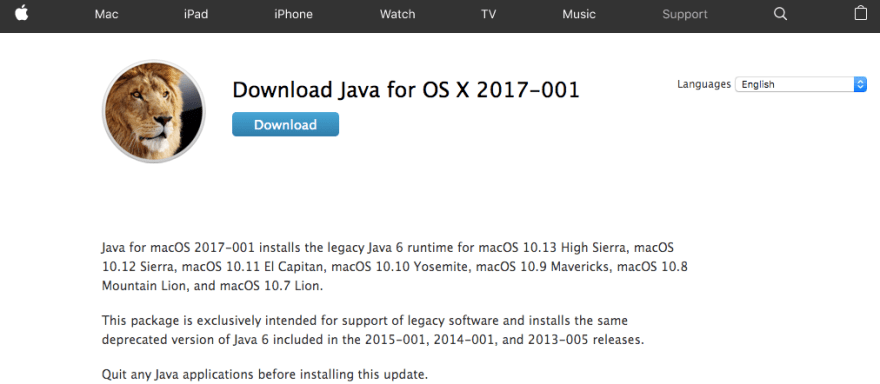
- Download Apple Java for OS X 10.7/10.8 for Mac to patch Java SE 6 components.
- I have the latest version of Java installed (currently Java(TM) SE Runtime Environment (build 1.8.0212-b10) via command java -version). I'm running Mac OS X 10.7 Lion. When I try to open the Java Control Panel by opening System Preferences and selecting Java, I get a spontaneous crash with the error: 'Java Control Panel quit unexpectedly.'
- Java for OS X also comes with a Control Panel that can be opened via the System Preferences window, using the Java preferences pane. This panel enables you to adjust the runtime network settings, as well as manage the temporary internet files stored by Java on your Mac's hard drive.
Download Java Control Panel For Mac Os X 10.77 Download Free
The Beginner's Guide to Aeronautics includes many Java applets to allow students to interactively try out their ideas about the math and science of airplanes, jet engines, kites, models rockets, and various sports. Java was chosen as the language for these computer programs because of its platform independence and widespread distribution. Unfortunately, the capability that Java provides for distributing and running educational programs also makes it attractive for hackers. During the summer of 2013, the increase in malicious Java software prompted the developers of Java to tighten the information technology (IT) security settings that are defaulted on many systems. As a result, we have been recieving reports from many users that our educational applets no longer execute on their computers.
We have not modified any of our software, and have received no reports of malware associated with our website. The IT security people are continuing to release new patches that will provide protection against hackers. We are providing the following instructions for adjusting your Java settings so that your computer is still protected while allowing you to use our software.
The following instructions work for the Windows Operating System (OS) - Window 7 and earlier :
Go to 'Programs' - select 'Java'
Select 'Security' - set to 'Medium'
Select 'Advanced' - scroll down to 'Mixed code (sandboxed vs. trusted) security verification'
Select 'Enable - hide warning and don't run untrusted code' or 'Disable verification (not recommended)'
For Window 8 and above the security settings are even tighter. On many systems, the Java JRE is not included in the operating system. You will have to download and install Java on your computer. It is free from Oracle and Microsoft support shows several different ways to download and install Java. By default, the JRE will block many applets. To allow the NASA Glenn educational software to run, you will have to open the the Java Control Panel:
Open the system 'Control Panel' and select 'Large Icon' display. Microsoft office mac free trial.
Select 'Security' - there is a 'Site Exception List' text box in which you enter 'trusted URL's'
Type in 'http://www.grc.nasa.gov/WWW/K-12/' and 'Apply' . this will allow you to run any of the java applets on the NASA Glenn central web server.
When you attempt to run our applets you will now receive a banner warning that Java programs can be dangerous, and asking whether you still want to execute the program. If you select 'yes', the programs will execute as before for most applets. Some applets display animated .gif images. The downloaded version of these applets do not display the images, while the on-line version show the images.
The following instructions work for Mac OS
First, install Java for your Mac if it is not installed, available from java.com Restart the MAC.
The MAC Control Panel allows you to find information about “Java” and configure Java settings. To launch the Java Control Panel on Mac OS X (10.7.3 and above), it is similar for earlier Macs.
- Click on Apple icon on upper left of screen.
- Go to System Preferences
- Click on the Java icon to access the Java Control Panel.
Now, create a Site Exception list to allow you to run the NASA applets. The exception site list is managed in the Security tab of the Java Control Panel. To add, edit or remove a URL from list, find and click Edit Site List and follow the directions:
Add a URL
- Click on the Edit Site List button.
- Click the Add in the Exception Site List window.
- Click in the empty field under Location field and enter the URL.
Example: https://www.grc.nasa.gov/WWW/K-12/ - Also do another one without the “s”
http://www.grc.nasa.gov/WWW/K-12/ - Click OK to save the URL that you entered.
- Click Continue on the Security Warning dialog.
These MAc instructions were sent by Glenn Shuster
The security patches are changing to meet new threats. Hopefully, they will allow for full Java implementation in the future.
Navigation .
- Beginner's Guide Home Page
On this page:
| The process of determining your Java version can be complex. Contact the IS&T Help Desk for assistance if needed. |
Windows
Option one: for Java 7 and higher, Java Control Panel
- Windows Control Panel > Java Control Panel
For more detailed instructions: https://www.java.com/en/download/help/win_controlpanel.xml - On the General tab, click About to display your Java version.
Option two: java -version
- Open a Command window.
- Click the Windows Start button, then type command.
- Command prompt application will appear in search results. Click to launch.
- At a command prompt, type java -version
- The results will tell you which version of Java is set as the default on your computer.
Additional steps
- The above steps will determine the default Java version for your computer.
- For security reasons, uninstall previous Java versions.
Mac OS X 10.7 and higher
Option one: for Java 7 and higher, Java Control Panel
- Apple > System Preferences > Java Control Panel
- On the General tab, click About to display your Java version.
Option two: java -version
NOTE: Contact the IS&T Help Desk for assistance if needed.
Download Java Control Panel Mac
- Launch Terminal. (Applications > Utilities > Terminal)
- At a command prompt, type java -version
- The results of the command will tell you which version of Java is set as the default on your machine.
Additional steps: Manually check for the existence of Java 6
- These instructions are for Mac OS 10.7 and higher. (Use Apple >> About this Mac to verify.)
- In Finder, on the Macintosh HD, check for the existence of the following folder:
System/Library/Java/JavaVirtualMachines/1.6.0.jdk - For Mac OS 10.7 and higher, [uninstall Java 6]
Mac OS X 10.6
- Java 7 is available only for Mac OS 10.7 and higher.
- Java 6 is packaged with the Macintosh operating system and will enable you to run Java applications. However, there are known security issues with Java 6. If at all possible, Apple recommends upgrading your operating system.